

AI has become a game-changer in cybersecurity monitoring and threat detection, transforming how you protect your digital assets. By utilizing advanced algorithms and machine learning techniques, AI systems can analyze vast amounts of data in real-time, identifying potential threats before they escalate into actual attacks. This proactive approach not only enhances your security posture but also reduces response times during incidents, allowing you to mitigate risks effectively. As cyber threats continue to evolve, embracing AI technology is imperative for staying one step ahead and safeguarding your critical information.

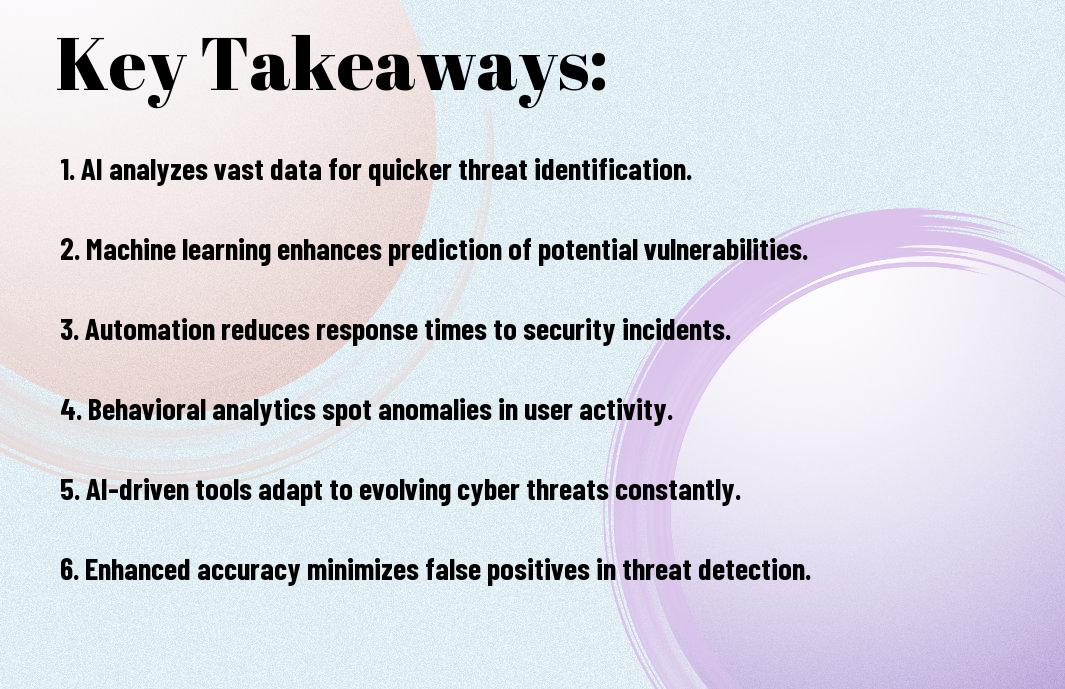
Key Takeaways:
- AI enhances the ability to analyze vast amounts of data in real-time, allowing for quicker identification of potential threats and anomalies that may go unnoticed by traditional methods.
- Machine learning algorithms continuously improve over time, adapting to new cyber threats and trends, thus increasing the overall effectiveness of cybersecurity systems.
- Automated threat detection and response capabilities can reduce the workload on cybersecurity professionals, enabling them to focus on more complex issues and strategies.
The Rise of AI in Cybersecurity
While traditional cybersecurity methods struggle to keep pace with evolving threats, How AI influences cybersecurity has become increasingly significant. The integration of AI empowers organizations to enhance their vigilance, automate threat detection, and respond to incidents more effectively, transforming how you safeguard your digital assets.
Historical Context
After years of manual monitoring and response to cyber threats, the landscape began to shift in the early 2000s as organizations acknowledged the limitations of traditional methods. The rise of complex cyberattacks necessitated the incorporation of more advanced technologies, paving the way for AI-driven solutions that could analyze vast amounts of data and identify patterns indicative of potential threats.
Current Trends
Along with the rapid evolution of cyber threats, organizations are increasingly adopting AI-driven tools that enable proactive threat detection and response. Machine learning algorithms are becoming imperative for identifying anomalies in network traffic and user behavior, allowing you to respond to threats in real-time.
But as you embrace these technologies, be aware of the balance between innovation and risk. While AI brings enhanced detection capabilities and faster incident response, it also opens doors for sophisticated new threats that can exploit AI systems themselves. Understanding these trends will help you not only leverage AI effectively but also safeguard your organization against potential vulnerabilities.
AI Techniques in Threat Detection
There’s a transformative impact of AI techniques on threat detection, significantly enhancing your ability to identify and respond to cyber threats. By leveraging advanced methodologies, these technologies empower your security systems to recognize patterns, prioritize alerts, and mitigate potential risks in real time.
Machine Learning Algorithms
Along with their ability to learn from vast datasets, machine learning algorithms automatically adapt to new threats by recognizing anomalies in your network traffic. This constant evolution improves the accuracy of threat detection, ultimately enabling you to preempt cyber attacks before they escalate.
Natural Language Processing
Language processing plays a vital role in analyzing unstructured data, like security alerts and logs. By employing natural language processing, your systems can efficiently sift through large volumes of text to extract pertinent information, filtering out noise and prioritizing critical alerts.
A natural language processing capability can dramatically enhance your cybersecurity monitoring by interpreting and contextualizing data from incident reports, user communications, and threat intelligence feeds. This helps you to identify potential vulnerabilities and trending attacks faster. Moreover, using sentiment analysis, it can even provide insights into the motivations behind certain cyber threats. Ultimately, these advancements equip you with the knowledge to reinforce your defenses and respond proactively to emerging risks.
Enhancing Monitoring with AI
For modern organizations, leveraging AI has become imperative for enhancing cybersecurity monitoring. With AI-driven systems, you can achieve greater efficiency in identifying and analyzing potential threats. AI technologies adapt and learn from incoming data, enabling you to stay one step ahead of attackers. Explore What Is the Role of AI in Threat Detection? to gain deeper insights into this transformation in cybersecurity.
Real-Time Analysis
On a daily basis, organizations face increasing threats that require immediate attention. AI enables real-time analysis of massive data streams, allowing you to identify anomalies and potential risks before they escalate into serious incidents.
Automated Incident Response
Across various industries, automated incident response systems powered by AI can significantly reduce response times. These systems can swiftly analyze threats and implement countermeasures without human intervention, ensuring that you can mitigate risks effectively.
Understanding the power of automated incident response means recognizing its ability to lower the risk of human error and speed up the decision-making process. By harnessing AI, you can ensure prompt actions against threats, ultimately preserving your organizational integrity and safety. This technology evaluates incidents, implements responses, and even learns from each encounter, constantly improving your defense mechanisms and providing greater protection against evolving cyber threats.

Limitations and Challenges of AI in Cybersecurity
Many organizations are eager to integrate AI into their cybersecurity frameworks, but they face several limitations and challenges. These include issues related to data quality, reliance on historical data, high implementation costs, and the potential for attack vectors that specifically target AI systems themselves. As you consider future enhancements, it’s important to recognize these obstacles and strategize accordingly to effectively leverage AI’s capabilities without becoming overly dependent on it.
False Positives and Negatives
An inherent challenge with AI in cybersecurity involves the occurrence of false positives and negatives, which can undermine your security efforts. While AI excels at identifying patterns, it can mistakenly flag benign activities as threats or, conversely, overlook sophisticated attacks. This can lead to wasted resources, disrupted operations, and a false sense of security, as you continuously balance between identifying genuine threats and avoiding unnecessary alarms.
Data Privacy Concerns
Any deployment of AI in cybersecurity raises significant data privacy concerns that must not be overlooked. The extensive data collection required for effective AI learning can inadvertently infringe on personal privacy and expose sensitive information. As you implement AI systems, it’s vital to ensure robust data management practices are in place to protect user privacy and maintain compliance with data protection regulations.
With the growing reliance on AI technologies, data privacy becomes a double-edged sword, as you must balance enhancing security measures with safeguarding your users’ information. AI systems often require access to vast datasets, raising the possibility of unintentional data breaches or misuse. You need to consider implementing strict data governance frameworks and ensuring transparency in how data is processed. Failing to address these privacy concerns can not only jeopardize trust but can also lead to severe legal ramifications, impacting both your organization and the individuals whose data you handle.
Future Trends in AI and Cybersecurity
Unlike traditional methods, the future of AI in cybersecurity will redefine threat detection and response strategies. As AI technologies advance, you can expect a shift towards more proactive measures, making systems smarter and more efficient. For a glimpse into this transformative change, check out How AI is Revolutionizing Cybersecurity in 2025.
Predictive Analytics
Analytics in cybersecurity are becoming increasingly sophisticated. By leveraging AI, organizations can analyze vast amounts of data to predict attacks before they happen. This proactive approach not only identifies potential threats but also provides insights for strengthening defenses, thereby significantly enhancing your security posture.
Integration with Other Technologies
On the horizon, the integration of AI with other cutting-edge technologies will reshape the cybersecurity landscape. You will witness seamless collaboration between AI, cloud computing, and the Internet of Things (IoT), making your security measures more robust.
Also, integrating AI with emerging technologies like blockchain can strengthen data integrity while enhancing incident response capabilities. This combination allows your organization to quickly adapt to potential threats. For instance, AI can automate threat detection across interconnected IoT devices, enabling real-time responses. The convergence of these technologies not only streamlines processes but also provides greater visibility into your overall security environment, empowering you to take action before threats materialize.
Case Studies of AI Implementation
Once again, many organizations have successfully integrated AI in their cybersecurity strategies, demonstrating impressive results. Here are a few notable case studies:
- Company A reduced incident response time by 50% using AI-driven analysis in threat detection.
- Company B increased their detection rate of sophisticated attacks by 75% after implementing machine learning algorithms.
- Company C’s implementation of AI resulted in a 40% decrease in false positives within their monitoring systems.
- Company D saved $1 million in potential damages by preemptively identifying vulnerabilities through AI.
Success Stories
Case studies show that organizations using AI for cybersecurity not only enhance their defenses but also streamline operations. The shifts toward automation and predictive analytics lead to greater innovation and efficiency in identifying threats.
Lessons Learned
Lessons learned from these implementations highlight the importance of adopting AI sensibly. You must ensure that your AI systems are regularly updated to adapt to the evolving threat landscape.
At the heart of the findings is the necessity for continuous learning. Incorporating feedback loops in your AI systems enables them to adapt to new threats dynamically. Moreover, emphasizing collaboration between human analysts and AI tools can maximize your defense strategy, as AI alone cannot tackle every potential vulnerability effectively. Balancing automated insights with expert judgment is vital for nurturing a resilient cybersecurity posture.
Conclusion
Conclusively, you can see how AI is transforming the landscape of cybersecurity monitoring and threat detection. With its ability to analyze vast amounts of data quickly and efficiently, AI empowers you to identify potential threats in real-time, enhancing your organization’s overall security posture. By incorporating machine learning algorithms, AI continuously evolves, adapting to new challenges and minimizing false positives. As you embrace these advanced technologies, you position yourself ahead of cybercriminals and fortify your defenses against the ever-evolving threat landscape.
Q: How does AI enhance the efficiency of cybersecurity monitoring?
A: AI enhances cybersecurity monitoring by automating threat detection processes and analyzing vast amounts of data in real-time. Traditional monitoring systems can struggle to keep up with the sheer volume of logs and alerts generated by network activity, leading to potential threats being overlooked. AI algorithms use machine learning to identify patterns and anomalies within this data, allowing for quicker identification of suspicious behaviors and a reduction in false positives. As a result, cybersecurity teams can focus on more significant threats and respond effectively, thereby improving overall security posture.
Q: What role does machine learning play in threat detection within AI systems?
A: Machine learning is a core component of AI systems in threat detection, as it enables these systems to learn from historical data and adapt to new threats over time. By training on past incidents, machine learning algorithms can develop models that predict and identify potential security breaches based on behavioral patterns. This continual learning process allows AI to stay ahead of evolving tactics used by cybercriminals, significantly improving the odds of timely detection and intervention. Consequently, organizations benefit from a more proactive security strategy rather than a reactive one.
Q: Are there limitations to AI in cybersecurity monitoring and threat detection?
A: While AI significantly improves cybersecurity monitoring and threat detection, there are limitations to consider. One major challenge is the reliance on quality data; AI systems need accurate, high-quality information to function effectively. If the input data is flawed or biased, it can result in poor detection capabilities or incorrect assessments of threats. Additionally, cybercriminals are constantly evolving their tactics, which can lead to scenarios where AI solutions may miss sophisticated attacks. Lastly, there can be concerns regarding the management of false positives and the operational costs associated with maintaining and updating AI systems. Organizations must address these limitations to maximize the effectiveness of AI in their cybersecurity strategies.