

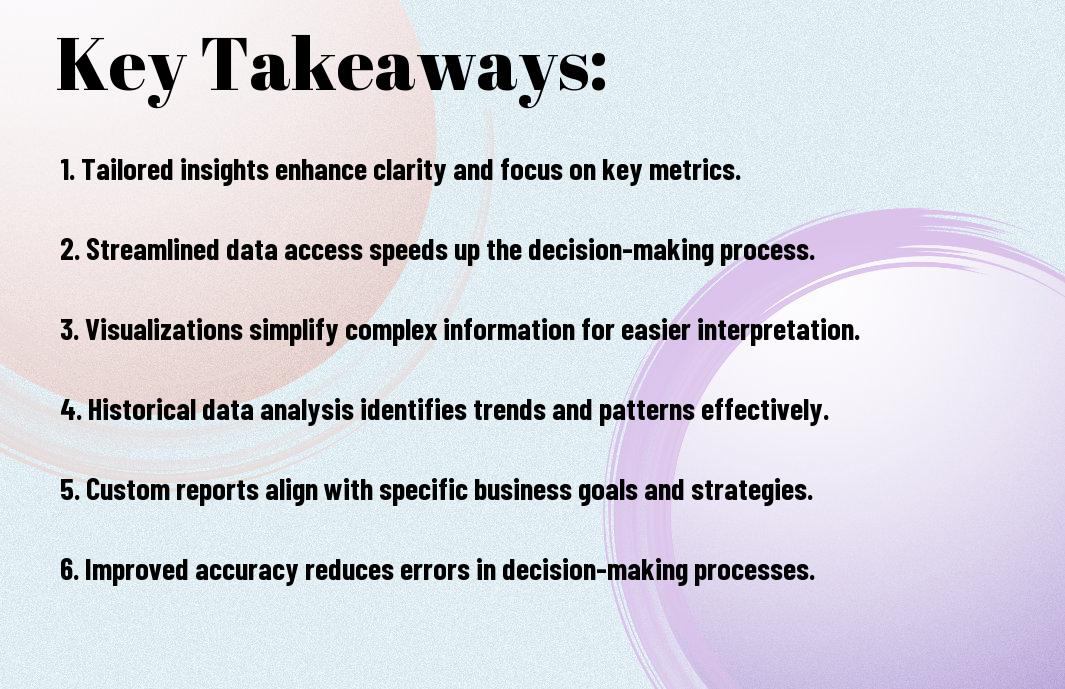
With the right insights at your fingertips, custom reporting can significantly enhance your decision-making process. Tailored reports help you identify trends, monitor performance, and uncover opportunities that standard reports might overlook. By focusing on relevant metrics, you can make data-driven choices that align with your business goals. This not only saves time but also reduces the risk of costly mistakes. To learn more on this topic and unlock the full potential of your data, check out Unlocking Business Insights: A Guide to Custom Reporting.
Understanding Custom Reporting
Your ability to make informed decisions hinges on the quality of data you analyze. Custom reporting tailors data insights specifically to your business’s needs, enhancing your understanding of performance metrics and trends. To dive deeper into this topic, check out The Benefits of Data Reporting.
Definition of Custom Reporting
Custom reporting refers to the process of creating tailored reports that focus on specific data elements and metrics, allowing businesses to gain deeper insights into their operations. These reports highlight the information most relevant to your unique business goals and can be generated using various software tools.
Importance in Business Context
With the fast-paced nature of today’s business environment, having access to tailored data insights is important for effective decision-making. Custom reporting provides you with information that is specifically relevant to your operational needs, enabling you to identify opportunities and challenges quickly. Without these insights, you risk making decisions based on incomplete or irrelevant data, which can lead to costly mistakes and missed opportunities.
Importance of custom reporting in your business context cannot be understated. It not only enhances your understanding of key performance indicators but also empowers you to identify trends that can significantly impact your strategic direction. Leveraging custom reports allows you to track critical metrics effectively, leading to informed decisions that positively affect your bottom line. By harnessing the power of customized data insights, you position yourself to navigate market challenges and capitalize on growth opportunities, ultimately fostering a more resilient and responsive business model.
The Role of Data in Decision-Making
It is vital to recognize that data serves as the foundation for informed decision-making in your business. By analyzing various datasets, you can uncover trends and patterns that guide your choices. As a result, leveraging custom reporting allows you to focus on the most relevant information, ultimately enhancing your strategic planning and execution. You gain a clear advantage when you can effectively interpret the data that drives your operational success.
Types of Data Leveraged
It’s important to understand the different types of data that can be leveraged in your custom reporting. Here are key categories:
- Sales Data
- Customer Feedback
- Market Trends
- Operational Metrics
- Financial Reports
Perceiving these diverse data types equips you with a comprehensive view necessary for optimal decision-making.
| Data Type | Description |
|---|---|
| Sales Data | Tracks performance metrics like revenue and unit sales. |
| Customer Feedback | Gathers insights from customer experiences and satisfaction. |
| Market Trends | Analyzes shifts in consumer behavior and preferences. |
| Operational Metrics | Measures efficiency and productivity of processes. |
| Financial Reports | Evaluates your overall fiscal health and profitability. |
Transformation of Data into Insights
Data can only be as powerful as the insights drawn from it. By transforming raw data into actionable insights, you gain the ability to make strategic decisions that drive growth. An effective transformation process involves analyzing data patterns, correlating disparate data sets, and producing relevant reports that align with your business goals. By adopting a structured approach towards data analysis, you can convert these findings into clear, strategic actions. Take note that the accuracy and timeliness of your insights can significantly impact your business outcomes. Hence, developing a disciplined methodology is key to steering your business toward success.

Benefits of Custom Reporting
All businesses can greatly benefit from custom reporting, which allows for tailored data analysis that aligns perfectly with your unique operational needs. By focusing on specific metrics, you can not only enhance your strategic planning but also gain insights that drive performance, reduce inefficiencies, and ultimately lead to better decision-making.
Enhanced Accuracy and Relevance
Behind the power of custom reporting lies its ability to deliver data that is both accurate and highly relevant to your specific goals. This means you can trust the insights generated, as they are based on metrics that matter most to your business, allowing for informed decisions that reflect your strategic objectives.
Time Efficiency and Cost Reduction
An effective custom reporting system can significantly streamline your data analysis processes, resulting in enhanced time efficiency and considerable cost reduction. By automating reporting tasks and focusing only on the key metrics, you can avoid the stubborn pitfalls of data overload and free up valuable resources.
To achieve greater time efficiency and reduce costs, implementing a custom reporting solution allows you to focus your efforts on data that directly affects your business outcomes. This not only minimizes the time wasted on irrelevant information but also enhances the overall productivity of your team. By allocating resources towards strategic initiatives instead of manual reporting tasks, you’ll create a more efficient workflow. The result is a substantial decrease in operational costs, empowering your business to invest more in growth-driven activities.
Implementing Custom Reporting Systems
Unlike traditional reporting methods that provide a generic overview of your business performance, custom reporting systems enable you to tailor reports specifically to your needs. By integrating these systems, you can focus on the unique metrics that drive your decision-making process. For a detailed guide on Creating Custom Reports for Informed Business Decisions, explore the valuable insights available.
Identifying Key Performance Indicators
Identifying the right Key Performance Indicators (KPIs) is important for effective custom reporting. These metrics should align with your business objectives, allowing you to track progress and make informed decisions. Start by evaluating your goals and determining which indicators will truly reflect your performance and guide your strategies.
Tools and Technologies for Reporting
After selecting the appropriate KPIs, it’s important to choose the right tools and technologies that facilitate effective custom reporting. Options like data visualization software, business intelligence platforms, and robust dashboard solutions are readily available to help you aggregate, analyze, and display your data effectively.
Implementing these advanced tools enhances your reporting capabilities, enabling you to create dynamic dashboards and interactive reports. Look for software that integrates seamlessly with your existing systems and offers customizable features that cater to your unique reporting needs. This will allow you to visualize trends and insights more effectively, leading to better decision-making and improved business outcomes.
Case Studies: Success Stories
For businesses seeking to enhance their decision-making processes, real-world examples can provide valuable insights. Here are some notable case studies that illustrate the power of custom reporting:
- Retail Chain A: Increased sales by 30% in 6 months using data-driven inventory reports.
- Tech Company B: Improved project delivery times by 25% by leveraging customized performance dashboards.
- Non-Profit Organization C: Enhanced donor engagement by 40% through tailored reporting on fundraising campaigns.
- Manufacturing Firm D: Reduced operational costs by 18% by analyzing production data more effectively.
Industry-Specific Examples
Above all, custom reporting yields various benefits across different sectors. For instance, in the healthcare industry, hospitals have used personalized reports to enhance patient care outcomes, while financial services have employed detailed analytics to identify market trends, leading to a 15% increase in client acquisition rates.
Lessons Learned from Implementation
Between various successful implementations of custom reporting, businesses learned necessary lessons regarding data utilization. Companies that prioritized training and stakeholder engagement saw a quicker adaptation and higher satisfaction rates among users. Additionally, focusing on key performance indicators (KPIs) crafted from real-world needs resulted in enhanced decision-making capabilities.
Implementation of custom reporting systems has shown that user engagement is vital. When you involve stakeholders early in the process and tailor reports to their specific needs, usage rates increase dramatically. Additionally, it’s important to analyze your key performance indicators effectively; firms that did so saw a direct correlation to business growth. However, overlooking the importance of data governance and security can lead to significant risks, so maintaining strict protocols is necessary for safeguarding sensitive information.

Challenges and Considerations
Not all custom reporting initiatives are smooth sailing. As you venture into crafting tailored reports, you may encounter several obstacles, including data integration issues, resource constraints, and user resistance. These challenges could hinder your ability to derive actionable insights, ultimately affecting your decision-making processes. It’s vital to navigate these issues strategically to ensure your custom reporting efforts yield the desired outcomes.
Common Hurdles in Custom Reporting
At times, you may face common challenges such as data silos, lack of technical expertise, or difficulties in aligning reporting with business goals. These hurdles can complicate the reporting process, leading to delays and incomplete analyses. You need to identify these points of friction early to mitigate their impact on your decision-making efficacy.
Strategies for Overcoming Obstacles
Along your reporting journey, implementing strategic solutions can help you overcome these challenges. Establishing clear goals, promoting cross-departmental collaboration, and investing in training for your team can streamline your custom reporting process. Furthermore, utilizing user-friendly reporting tools can enhance engagement and data interpretation across your organization.
Custom reporting is not just about the data; it’s about making it work for you. Focus on ensuring that your reports are developed with clear objectives in mind. Engage your team through training sessions and encourage collaboration to break down data silos. Choosing intuitive reporting software can also empower your users, making it easier for them to interact with the data and derive insights. Address these obstacles proactively to transform challenges into opportunities for enhanced decision-making.
To wrap up
Drawing together insights from your custom reporting can significantly enhance decision-making in your business. By tailoring reports to focus on key performance indicators and specific data points relevant to your objectives, you can gain a clearer understanding of your operations. This allows you to identify trends, forecast outcomes, and make informed choices that align with your strategic goals. Ultimately, leveraging custom reporting empowers you to transform data into actionable insights, ensuring that your decisions are both timely and impactful, driving your business forward.